
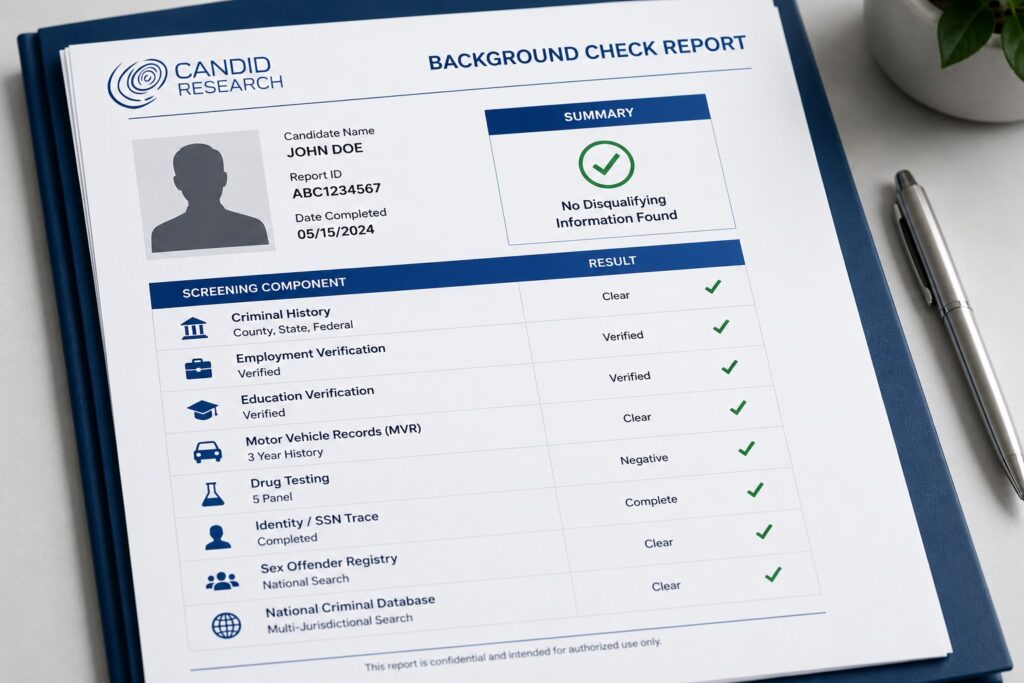
Employment background checks may include criminal history, employment verification, education verification, drug testing, driving records, and other screening components depending on the position and employer requirements.
Employers use background checks to verify information, evaluate risk, and support informed hiring decisions. But many employers and candidates are unsure what actually appears on a background check report.
The answer depends on the types of searches being ordered, the position being filled, and applicable federal and state laws.
Most employment background checks combine several searches to provide a broader picture of a candidate’s history and qualifications.
What Information Can Appear on a Background Check?
Employment background checks may include a combination of the following:
- Criminal history searches
- Employment verifications
- Education verifications
- Motor vehicle records (MVR)
- Professional license verification
- Drug testing results
- Identity and address history research
- Sex offender registry searches
- Federal criminal searches
- National criminal database searches
Not every employer orders every search. Screening packages are typically customized based on the position and company policy.
Criminal History Searches
Criminal background checks are one of the most common components of employment screening.
These searches may include:
- County criminal searches
- Federal criminal searches
- National criminal database searches
- Sex offender registry searches
Information that may appear includes:
- Felony convictions
- Misdemeanor convictions
- Pending criminal cases
- Sentencing information
- Disposition details
Reporting rules vary by state and jurisdiction, particularly regarding reporting timeframes and salary thresholds.
Employment Verification
Employment verification confirms a candidate’s previous work history.
Employers may verify:
- Company names
- Dates of employment
- Job titles
- Rehire eligibility
- Reasons for separation when available
Verification delays can occur when employers do not respond promptly or require manual confirmation through human resources departments.
Education Verification
Education verification confirms degrees, diplomas, certifications, or attendance history claimed by the candidate.
Employers may verify:
- Schools attended
- Degrees earned
- Graduation dates
- Certifications or training programs
This is especially common for professional, healthcare, financial, and management positions.
Motor Vehicle Records (MVR)
An MVR search reviews a candidate’s driving history through state motor vehicle agencies.
An MVR may reveal:
- Driver’s license status
- Suspensions or revocations
- Traffic violations
- Accident history
- CDL status when applicable
MVR searches are commonly used for driving positions or roles involving company vehicles.
Drug Testing Results
Drug testing may also be part of the screening process.
Programs may include:
- DOT drug testing
- Non-DOT drug testing
- Pre-employment testing
- Random testing
- Post-accident testing
Testing panels and reporting rules vary depending on employer policy and applicable laws.
Identity and Address History Research
Many employers use SSN Trace research tools to help identify names and jurisdictions associated with a candidate over time.
An SSN Trace may help identify:
- Previous names
- Aliases
- Former addresses
- Jurisdictions connected to the candidate
This information helps develop more accurate criminal search strategies.
What Does NOT Usually Appear?
Many people assume background checks automatically include everything about a person. That is not accurate.
Most employment background checks do not include:
- Medical history
- Bank account information
- Protected personal information
- Social media passwords
- Sealed or expunged records where prohibited by law
Employers must comply with the Fair Credit Reporting Act (FCRA) and applicable state laws when conducting employment screening.
Why Background Checks Vary
No two background checks are exactly the same.
The information included depends on:
- Employer policy
- Position requirements
- Industry regulations
- State and local laws
- The screening package selected
For example, a staffing agency hiring warehouse workers may order different searches than a transportation company hiring CDL drivers.
Final Thoughts
Background checks can include many different types of searches depending on the position and the employer’s screening program.
Understanding what may appear on a background check helps employers make informed hiring decisions while helping candidates better understand the screening process.
Comprehensive background screening programs often combine multiple searches to provide a more complete picture of a candidate’s history and qualifications.