
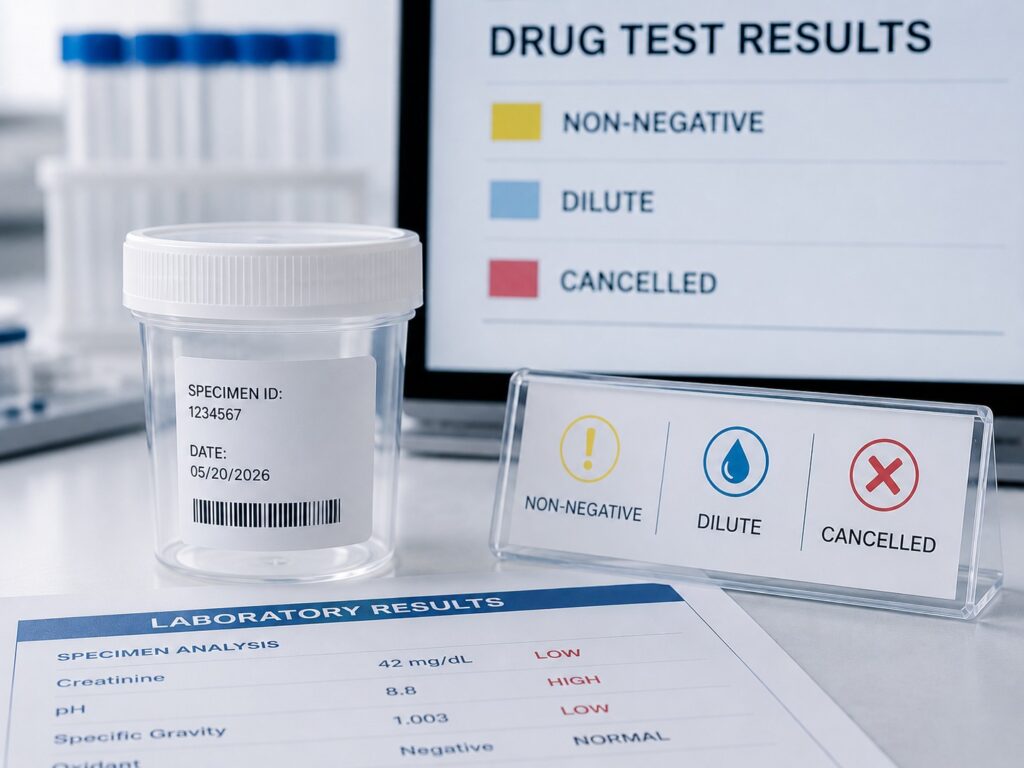
Why some drug test results require additional lab testing, MRO review, or specimen validity review before a final result is reported.
Drug test results are not always as simple as “negative” or “positive.”
In some situations, employers or applicants may receive results described as dilute, non-negative, cancelled, or pending Medical Review Officer (MRO) review. These results can create confusion, especially when a rapid test does not immediately return a final negative result.
Understanding what these terms mean can help employers and applicants better understand the drug testing process and why additional review or laboratory testing may sometimes be required.
What Does “Non-Negative” Mean?
A non-negative result does not automatically mean a person failed the drug test.
Instead, it generally means the initial screening detected something requiring additional laboratory confirmation and review.
Many rapid or instant drug tests are considered preliminary screening tools. If the initial result is not clearly negative, the specimen is often sent to a certified laboratory for confirmatory testing.
This additional review process helps improve accuracy and reduce the risk of false positive results.
Why Would a Rapid Drug Test Be Sent to the Lab?
Rapid tests are commonly used for convenience and speed, but they are not considered final confirmatory testing methods.
A rapid test may be sent to a laboratory when:
- The result is non-negative
- The test device produces an unclear result
- Confirmation testing is required by employer policy
- DOT or regulated testing rules apply
- Specimen validity concerns exist
- A Medical Review Officer review is required
Laboratory confirmation testing uses more sophisticated scientific methods designed to confirm or rule out the presence of specific substances.
What Is a Medical Review Officer?
A Medical Review Officer, often called an MRO, is a licensed physician specially trained to review laboratory drug test results.
The MRO’s role is to:
- Review confirmed laboratory results
- Contact the donor when necessary
- Determine whether there may be a legitimate medical explanation
- Verify final reportable results
For example, certain prescription medications may produce laboratory findings that require MRO review before a final result is reported to the employer.
MRO review is mandatory for all DOT-regulated drug testing. For non-DOT testing, MRO involvement may vary depending on employer policy and applicable requirements. Employers subject to DOT regulations should be aware that their compliance obligations differ from standard workplace testing programs.
This process helps promote accuracy, fairness, and confidentiality.
What Does “Dilute” Mean?
A dilute result means the urine specimen contained more water and lower concentrations of normal substances than expected.
This may occur for many reasons, including:
- High fluid intake
- Hydration before testing
- Natural biological variation
- Medical conditions
- Other specimen collection factors
Dilute results are not automatically positive or negative.
What Is a Negative Dilute Result?
A negative dilute result means:
- No drugs were detected above testing thresholds
- The specimen showed signs of dilution
Some employers may accept negative dilute results as final. Others may require a retest depending on company policy, industry requirements, or applicable regulations.
Under DOT regulations, a negative dilute result may trigger a mandatory recollection depending on the creatinine level of the original specimen. Employers subject to DOT requirements should follow applicable federal guidelines rather than standard workplace testing policies.
What Is a Positive Dilute Result?
A positive dilute result means:
- Drugs or metabolites were confirmed above reporting thresholds
- The specimen also showed signs of dilution
These situations may still require standard MRO review procedures before final reporting.
What Does “Cancelled” Mean?
A cancelled test means the laboratory or MRO could not report a final result from the specimen provided.
Cancelled results may occur for several reasons, including:
- Insufficient specimen volume
- Specimen leakage or shipping damage
- Laboratory processing issues
- Invalid specimen results
- Specimen validity concerns
- Testing interference
A cancelled test does not automatically mean the donor attempted to tamper with the specimen.
In many cases, the employer may simply require recollection.
It is also worth noting that cancelled tests are generally still billable. Laboratory processing, specimen handling, and administrative review occur regardless of whether a final result is reported. Employers should not assume that a cancelled result means the test was not conducted or that associated fees will not apply.
What Does “Cancelled Due to Abnormal pH” Mean?
Urine specimens are tested for certain validity indicators, including pH levels.
An abnormal pH result may indicate the specimen fell outside expected biological ranges.
Possible causes may include:
- Chemical contamination
- Specimen adulteration
- Collection or storage issues
- Certain medical or environmental factors
Depending on the circumstances, the laboratory or MRO may cancel the test and recommend recollection.
What Does “Cancelled Due to Creatinine” Mean?
Creatinine is a naturally occurring waste product normally present in urine.
Very low creatinine levels may indicate an unusually dilute specimen.
When creatinine or related specimen validity markers fall outside acceptable ranges, the laboratory may determine the specimen is not suitable for reporting and cancel the test.
Additional testing or recollection may sometimes be required.
Why Do Some Drug Test Results Take Longer?
Drug testing timelines vary depending on:
- Type of test performed
- Laboratory confirmation requirements
- MRO review status
- Specimen validity testing
- Shipping and laboratory processing times
- Employer reporting procedures
A rapid negative result may sometimes be available quickly, while non-negative or validity-related results may require additional review before a final result can be released.
Common Misunderstandings
“Non-Negative Means Positive”
Not necessarily. Non-negative generally means additional confirmation testing or review is required.
“Dilute Means Someone Tried to Cheat the Test”
Not always. Dilution can occur for many reasons, including normal hydration.
“Cancelled Means the Person Failed”
No. Cancelled tests often involve technical or specimen validity issues rather than confirmed drug findings.
“Rapid Tests Are Always Final”
Rapid tests are preliminary screening tools and may require laboratory confirmation depending on the result.
Final Thoughts
Drug testing involves multiple scientific and review processes designed to promote accuracy, fairness, and compliance.
Results such as dilute, non-negative, or cancelled do not always indicate drug use or policy violations, but they may require additional laboratory analysis or MRO review before final reporting.
For employers, understanding these result types can help reduce confusion during the hiring process.
For applicants, understanding why a result may be delayed or require additional review can help provide important context during screening.