
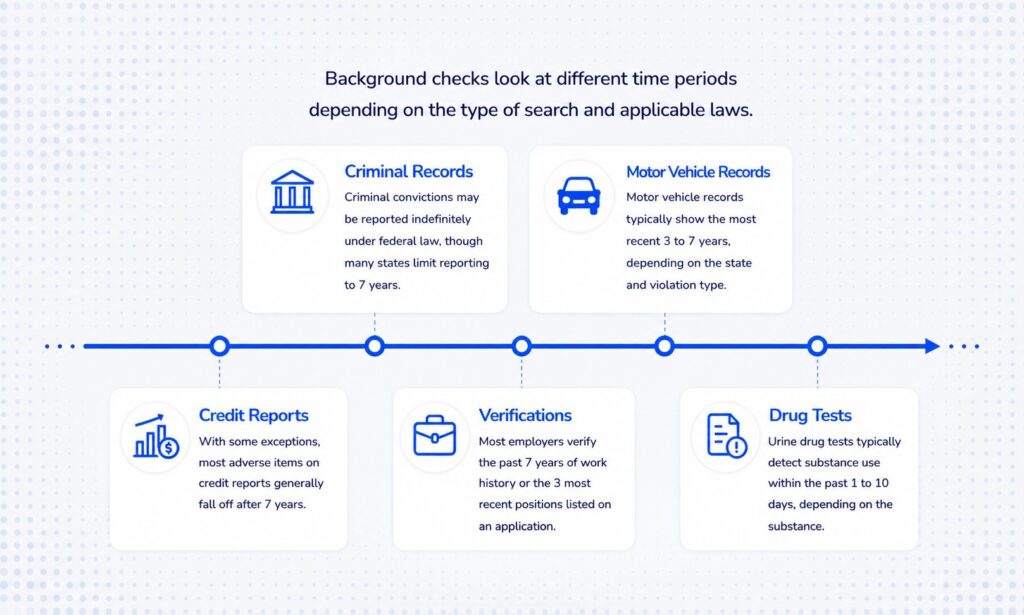
Background check reporting timeframes vary depending on the type of search being conducted, applicable state laws, employer policies, and the position being filled.
One of the most common questions employers and candidates ask is: “How far back does a background check go?”
The answer depends on several factors, including:
- the type of search being conducted
- federal and state laws
- the position being filled
- employer screening policies
There is no single universal timeframe that applies to every employment background check.
The 7-Year Rule
Many people believe all background checks only go back seven years. That is not always accurate.
The Fair Credit Reporting Act (FCRA) allows criminal convictions to be reported indefinitely, while non-conviction records are generally limited to 7 years.
Beyond federal law, many states have their own stricter rules that further limit reporting on convictions.
Salary thresholds, position type, and jurisdiction can all affect what is reportable and for how long.
When Does the Reporting Clock Start?
When the reporting period begins depends on the type of record. For non-conviction records, the FCRA generally starts the clock from the date of the offense or disposition. For periods of incarceration, some states start the clock from the date of release or end of parole. Employers should be aware that the start date can significantly affect what appears on a background check.
Criminal Background Checks
Criminal history reporting timeframes depend heavily on:
- state law
- the type of record
- the nature of the offense
- salary thresholds in some jurisdictions
In many states:
- felony convictions may be reportable indefinitely
- misdemeanor reporting rules may vary
- pending cases may still be reportable
Open cases, unresolved charges, and outstanding arrest warrants are generally reportable in most states. Because these represent active legal matters with no final disposition, they are typically not subject to the same reporting limitations that apply to closed cases. Employers should consider how their screening policies address pending or unresolved matters.
Some states place stricter limits on how far back criminal records can be reported for employment purposes.
Because laws differ by state, employers should ensure their screening programs comply with all applicable regulations.
County vs. Federal Criminal Searches
How far a criminal search goes back also depends on the type of search being performed.
County Criminal Searches
County criminal searches review records maintained by local county courts.
Coverage depends on:
- court retention practices
- available electronic records
- physical or archived record access
Some county courts maintain records for decades, while others may have more limited historical access.
Federal Criminal Searches
Federal criminal searches review records within the federal court system.
Federal records may include:
- fraud cases
- embezzlement
- interstate crimes
- federal drug offenses
- white-collar crimes
Federal courts often maintain records extending back many years.
Employment and Education Verifications
Employment and education verifications are generally not restricted to a specific number of years.
Employers may request verification of:
- previous employers
- degrees earned
- certifications
- licenses or professional credentials
However, older records can sometimes be more difficult to obtain due to:
- employer closures
- record retention policies
- unavailable archives
Motor Vehicle Records (MVR)
Motor vehicle records are typically governed by state driving record retention rules.
Depending on the state, MVR reports may show:
- recent violations
- accidents
- suspensions
- CDL status
- driving-related offenses
Reporting timeframes vary by state motor vehicle agency. Serious offenses such as DUI may remain on record longer than standard violations.
Credit Reports
When permitted for employment purposes, credit reports are subject to FCRA limitations.
Most adverse credit information is not reportable after seven years, including:
- late payments
- collection accounts
- charge-offs
Chapter 7 bankruptcy is a notable exception and may be reported for up to 10 years.
Employers must also comply with state-specific laws regarding employment credit checks, as many states restrict or prohibit the use of credit history in hiring decisions.
Why Background Check Timeframes Vary
No two background checks are exactly alike.
The reporting period may depend on:
- state law
- employer policy
- industry regulations
- position sensitivity
- salary level
- search type
For example:
- a DOT-regulated position may involve additional compliance requirements
- healthcare or security-sensitive roles may require expanded searches
- a financial position may warrant more extensive screening due to fiduciary responsibility
Final Thoughts
There is no universal answer to how far a background check goes back.
The timeframe depends on the searches ordered, applicable laws, court record availability, and employer requirements.
Employers should work with a knowledgeable background screening provider to ensure their screening programs remain compliant while delivering accurate and relevant information for hiring decisions.