
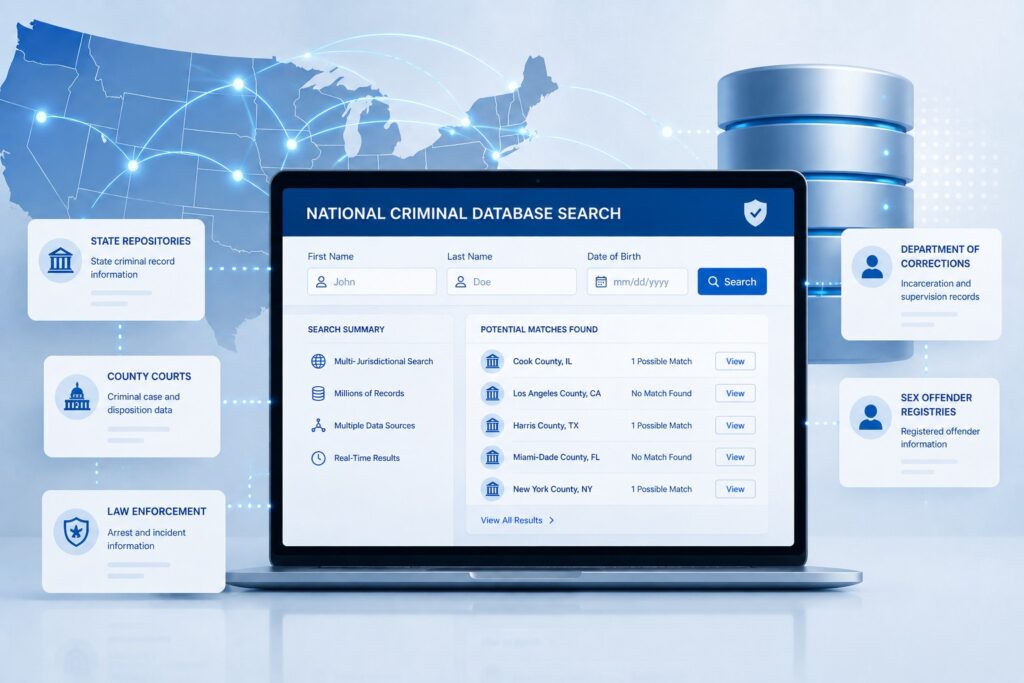
National criminal database searches help employers identify possible criminal records across multiple jurisdictions and are commonly used as part of broader employment background checks.
A national criminal database search, sometimes referred to as a multi-jurisdictional criminal database search, is commonly used as part of employment criminal background checks. These searches help employers identify possible criminal records across multiple jurisdictions quickly and cost-effectively.
However, many employers misunderstand what a national criminal database search actually does — and what it does not do.
Understanding how these searches work is important when building a compliant and reliable background screening program.
What Is a National Criminal Database?
A national criminal database is a large collection of criminal record information compiled from various public and proprietary sources across the United States.
Depending on the provider, database records may include information from:
- County courts
- State repositories
- Department of Corrections records
- Administrative office records
- Sex offender registries
- Watchlists and sanctions data
- Other publicly available criminal justice sources
These databases are designed to help identify possible records associated with an applicant’s name and date of birth.
How Employers Use National Criminal Database Searches
National criminal database searches are primarily used as a screening tool to help identify jurisdictions that may require further investigation.
Because they can search millions of records quickly, they are commonly used to:
- Expand search coverage
- Identify records outside an applicant’s disclosed history
- Increase screening efficiency
- Help locate potential criminal records across multiple states
Many employers use multi-jurisdictional searches to identify possible records across multiple states and counties more efficiently.
Employers often include national criminal database searches as part of broader criminal background checks alongside county criminal searches, federal criminal searches, and SSN Trace results.
Important Limitations
A national criminal database search is not considered a complete criminal background check by itself and is therefore, not recommended as a stand-alone product.
Databases may contain:
- Incomplete information
- Delayed updates
- Missing dispositions
- Reporting gaps between jurisdictions
For this reason, potential records identified in a database search must be verified directly at the originating court before being reported on a criminal background check.
This court-level verification helps support accuracy and FCRA compliance.
Why County Criminal Searches Still Matter
County criminal searches remain one of the most important components of criminal background checks because criminal cases are typically filed and maintained at the county court level.
A county search may provide:
- More current information
- Better disposition details
- More complete case information
- Improved accuracy for employment decisions
National criminal database searches and county criminal searches are often used together rather than as replacements for one another.
What Information May Appear in a National Criminal Database Search?
Potential records may include:
- Felony charges
- Misdemeanor charges
- Convictions
- Pending cases
- Incarceration records
- Registered sex offender records
However, available information varies significantly depending on the reporting source and jurisdiction.
Final Thoughts
A national criminal database search can be a valuable tool for expanding search coverage and identifying possible criminal records across multiple jurisdictions.
However, database searches should generally be viewed as a supplement to court-level criminal background checks — not a replacement for them.
A well-designed screening program combines multiple search types to improve visibility, support compliance, and help employers make more informed hiring decisions.