
Hiring decisions carry risk. Employers want to protect their workplace, customers, reputation, and team. At the same time, applicants have legal rights that must be respected throughout the background screening process.
That is where the Fair Credit Reporting Act, commonly called the FCRA, becomes critical.
The FCRA is the primary federal law governing employment background checks conducted by third-party Consumer Reporting Agencies. It establishes rules for obtaining, using, and handling background reports while also protecting consumer privacy and promoting accuracy.
Many employers assume FCRA compliance is simply about getting a signed authorization form. It is not.
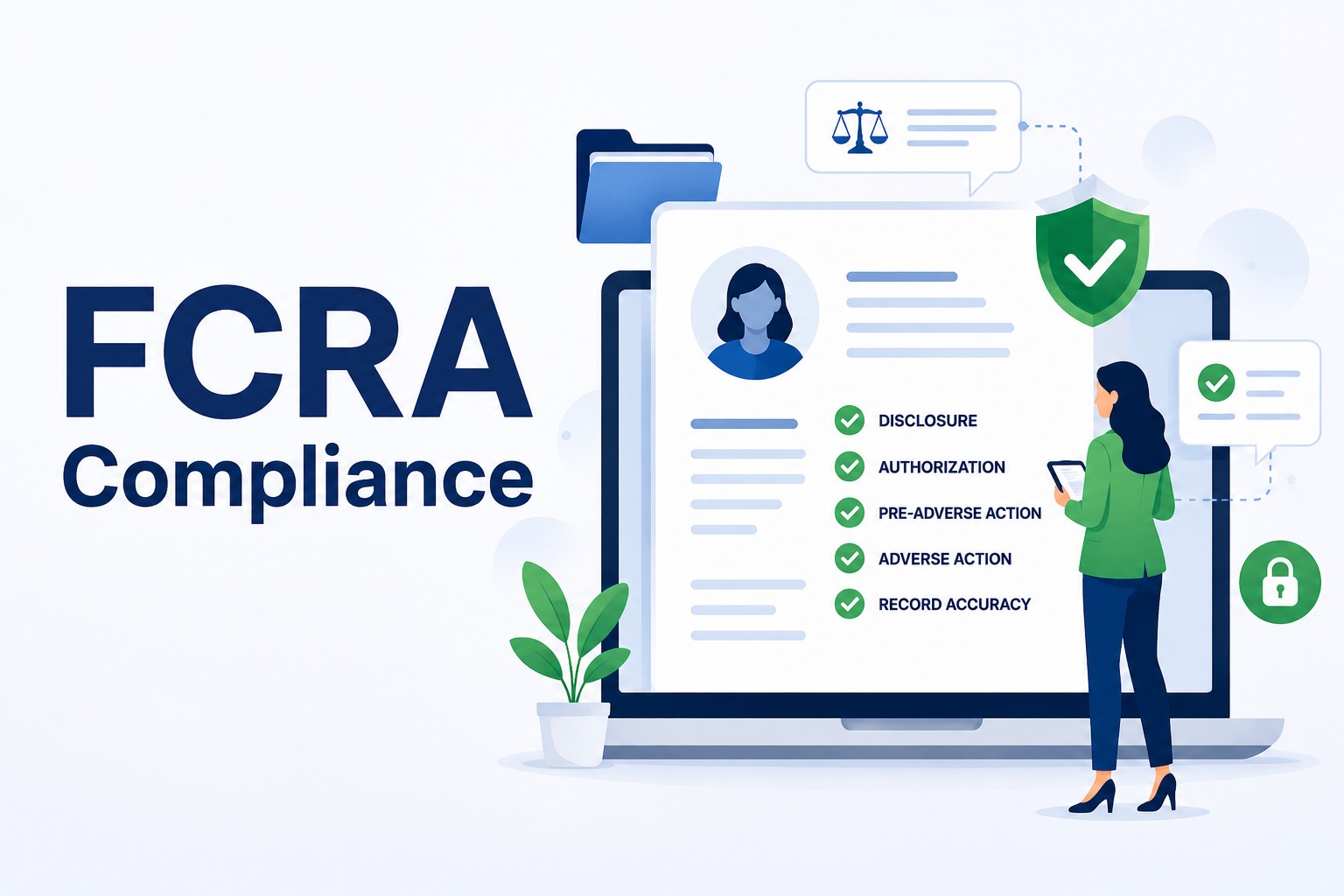
The law affects nearly every stage of the screening process, including disclosure and authorization, report accuracy, applicant rights, adverse action procedures, dispute handling, data use, and recordkeeping.
Even small mistakes can create significant legal exposure. Technical violations alone have resulted in expensive lawsuits and class-action settlements against employers across the country.
Understanding how the FCRA works helps employers build safer, more compliant hiring practices while protecting both applicants and their organization.
What Is the FCRA?
The Fair Credit Reporting Act is a federal law originally enacted to regulate how consumer information is collected, shared, and used. While many people associate the FCRA with credit reports, the law also governs employment background checks when reports are prepared by a third-party background screening company.
If an employer uses a background screening company to obtain information about an applicant or employee, the FCRA likely applies.
This can include reports involving criminal history, employment verification, education verification, credit history, motor vehicle records, professional licenses, drug testing results, reference interviews, identity verification, and civil records.
The law applies regardless of company size. A small business hiring one employee and a national company hiring thousands are both expected to comply.
What Is a Consumer Reporting Agency?
A Consumer Reporting Agency, often called a CRA, is a company that assembles or evaluates consumer information for employment purposes. Background screening companies fall into this category.
CRAs help employers obtain and verify information while maintaining procedures designed to promote accuracy and compliance.
Examples of services commonly provided by CRAs include criminal record searches, employment verification, education verification, motor vehicle reports, drug testing coordination, identity research, compliance support, and adverse action tools.
Employers should work with a reputable CRA that understands FCRA requirements and maintains strong quality-control procedures.
Why the FCRA Matters
The FCRA exists to balance two important interests. Employers need reliable information to make informed hiring decisions, and consumers deserve fairness, transparency, and the opportunity to dispute inaccurate information.
Without safeguards, applicants could be denied employment based on incorrect criminal records, mixed files, outdated information, identity confusion, incomplete records, or data-entry errors.
The FCRA establishes standards intended to reduce those risks.
For employers, compliance is not optional. Failure to follow FCRA procedures can lead to lawsuits, regulatory investigations, financial penalties, reputational damage, and operational disruption.
When Does the FCRA Apply?
The FCRA generally applies when an employer hires a third-party company to conduct a background check and uses the report for employment purposes.
This includes pre-employment screening, promotions, reassignments, retention decisions, contractor screening, and some volunteer screening programs.
The law may still apply even if the employer never reviews the report directly. If the report is obtained for employment purposes through a CRA, FCRA obligations should be considered.
The FCRA Background Check Process
Understanding the full compliance workflow is essential. Employers should not treat background screening as a single transaction. It is a process with specific steps before, during, and after the report is completed.
Step 1: Provide a Clear Disclosure
Before obtaining a background check, employers must provide a clear disclosure informing the applicant that a consumer report may be obtained for employment purposes.
This disclosure should be clear, conspicuous, and separate from unrelated application materials.
One of the most common employer mistakes is combining the disclosure with unrelated language, such as liability waivers, broad legal releases, employment policies, or extra acknowledgments.
The safest approach is to keep the disclosure simple and focused on the background check.
Step 2: Obtain Written Authorization
Employers must obtain written authorization before ordering the report. Authorization may be paper-based or electronic.
Many employers now use electronic disclosure and authorization systems for efficiency and recordkeeping. Regardless of format, the authorization should be retained as part of the employer’s compliance records.
Step 3: Certify Compliance to the CRA
Before providing reports, the CRA generally requires employers to certify that they will follow FCRA requirements, use reports only for permissible employment purposes, comply with adverse action procedures, and avoid discriminatory use of information.
This certification is usually included in the client service agreement.
Step 4: The CRA Conducts the Background Check
The CRA then gathers and verifies information from appropriate sources. Depending on the screening package, this may include county criminal courts, federal courts, national databases, sex offender registries, employment records, educational institutions, motor vehicle departments, and professional licensing boards.
Many employers mistakenly assume all criminal data comes from one national source. That is not how background screening works.
National criminal databases are only one research tool and often contain incomplete or limited information.
Related articles:
- What Is a National Criminal Database Search?
- Why Some Criminal Records Are Missing From Databases
- County vs. Federal Criminal Searches
Step 5: Review the Results Carefully
A background report does not automatically determine whether someone should or should not be hired. Employers should evaluate findings carefully and consistently.
Relevant considerations may include job relevance, the nature of the offense, severity, time passed, rehabilitation, state and local laws, and individual circumstances.
Automatic disqualification policies can create compliance risk, especially when criminal history is considered without context.
Related articles:
Step 6: Follow Pre-Adverse Action Procedures
If an employer may take negative action based in whole or in part on the background report, the FCRA requires a pre-adverse action process.
Before making a final decision, the employer must generally provide the applicant with a pre-adverse action notice, a copy of the report, and a Summary of Rights under the FCRA.
The applicant must then be given a reasonable opportunity to review and dispute the information.
This step exists because background reports can contain errors or incomplete information.
Related article: Understanding Pre-Adverse Action
Step 7: Send the Final Adverse Action Notice
If the employer ultimately proceeds with the negative decision, a final adverse action notice must be provided.
This notice generally includes notification of the decision, CRA contact information, a statement that the CRA did not make the hiring decision, and notice of the consumer’s right to dispute the report.
Failure to follow proper adverse action procedures is one of the most common causes of FCRA litigation.
Common Employer FCRA Mistakes
Combining Disclosure Forms
Adding liability waivers, policy acknowledgments, or unrelated legal language to the disclosure form can create compliance concerns.
Skipping Pre-Adverse Action
Some employers move directly to rejection without providing the required notice, report copy, and opportunity to dispute.
Using Outdated Forms
FCRA forms should be reviewed regularly to make sure they remain current and appropriate.
Relying Solely on Databases
Database searches alone may not provide complete or current criminal information. Court-level verification remains important.
Related article: Why Some Criminal Records Are Missing From Databases
Applying Blanket Hiring Policies
Automatically disqualifying anyone with a criminal record can create legal exposure under the FCRA, state laws, local laws, and fair hiring guidance.
Failing to Document Procedures
Employers should maintain documentation showing that compliance steps were followed consistently.
Accuracy Matters
The FCRA requires CRAs to maintain reasonable procedures to assure maximum possible accuracy.
Accuracy is one of the law’s central principles because background reports may involve similar names, multiple jurisdictions, incomplete court data, delayed updates, identity confusion, or conflicting records.
Responsible screening companies use layered review procedures to reduce errors and resolve inconsistencies.
This may include verifying identifiers, reviewing date-of-birth information, checking court dockets, confirming dispositions when available, and resolving conflicting information before reporting.
How Long Can Information Be Reported?
The FCRA includes reporting limitations for certain types of information. However, rules can vary depending on the type of record, the position, salary level, and applicable state law.
Many states impose stricter rules than federal law, especially for criminal history reporting.
Employers should avoid assuming that one national rule applies everywhere.
Related article: How Far Back Does a Background Check Go?
State and Local Laws Also Matter
FCRA compliance alone is not enough.
Employers must also consider state laws, local ordinances, Ban the Box laws, Fair Chance Hiring laws, and industry-specific rules.
These laws may regulate when criminal history can be considered, what notices must be provided, how long employers must wait before making a final decision, and whether individualized assessments are required.
Related article: What Is Ban the Box?
Understanding Common Background Check Components
SSN Trace
An SSN Trace is primarily a research tool. It may help identify associated names, alias names, address history, and jurisdictions for additional research. It is not a criminal search by itself.
Related article: What Is an SSN Trace?
County Criminal Searches
County criminal searches are often considered a primary source for criminal record research because most criminal cases originate at the county level.
Related article: County vs. Federal Criminal Searches
Federal Criminal Searches
Federal searches involve crimes prosecuted in U.S. District Courts. Examples may include wire fraud, embezzlement, federal tax offenses, and certain interstate crimes.
National Criminal Databases
National databases compile criminal data from many sources, but coverage and update frequency vary. These databases are useful research tools, but they should not be treated as complete nationwide court searches.
Related article: What Is a National Criminal Database Search?
Motor Vehicle Reports
MVR reports may include license status, suspensions, traffic violations, accidents, and DUI-related records. These reports are especially important for driving-related positions.
Related article: What Is an MVR Report?
Drug Testing
Drug testing may involve additional state, federal, and industry-specific requirements. Employers should understand the difference between DOT and non-DOT testing programs.
Related article: DOT vs. Non-DOT Drug Testing
Choosing a Background Screening Partner
Not all CRAs operate the same way. Employers should look for a provider that offers responsive support, compliance guidance, clear reporting, accurate research procedures, adverse action tools, secure systems, and consistent communication.
Fast turnaround times matter, but accuracy and compliance matter more. A report completed quickly but inaccurately can create serious risk.
Employers using AI-powered hiring or screening tools should confirm those systems comply with FCRA requirements, as use of this technology may trigger the same notice and consent obligations as traditional background reports.
Best Practices for Employers
Use Standardized Procedures
Use consistent screening procedures across departments whenever possible.
Keep Forms Updated
Review disclosure, authorization, and adverse action forms regularly to ensure your organization is using current versions required by federal regulations. The CFPB updates model forms and compliance language as regulations change, and outdated documents may create unnecessary compliance risk.
Train HR Personnel
Make sure HR teams understand pre-adverse action, adverse action, Ban the Box, Fair Chance Hiring, and state-specific restrictions.
Document Compliance Steps
Maintain records of authorizations, notices, adverse action communications, screening policies, and applicant communications.
Evaluate Records Individually
Review findings in context instead of relying only on blanket disqualification rules.
The Cost of Non-Compliance
FCRA lawsuits can be expensive even when no actual harm occurred. Many cases focus on technical violations involving disclosure forms, authorization procedures, and adverse action notices.
Employers have faced large settlements, legal fees, regulatory scrutiny, and reputational damage because of avoidable compliance mistakes.
Proactive compliance is far less expensive than reactive litigation.
Final Thoughts
The FCRA is not simply paperwork. It is the legal framework governing how employers obtain, use, and act on background information.
Understanding the law helps employers protect applicants’ rights, improve hiring consistency, reduce compliance exposure, and make more informed decisions.
Background screening works best when it balances workplace safety, fairness, accuracy, and compliance.
As regulations continue evolving, employers should regularly review their screening practices and work with an experienced, compliance-focused screening partner.